Some Places Never Leave You
There is a bench. At the end of a pier, in a city you only spent two days in. That's where you realized you were in love. You no longer remember the name of the street. You might not even find the neighborhood again. But that bench is still there — somewhere in your memory, with the exact light of that evening, the smell of the river, and the sound of that voice.
There are places like that. Places that no longer quite exist on a map.
A place is not a set of coordinates
We tend to think of a place as a point. A latitude, a longitude. A pin on Google Maps. Something fixed, neutral, interchangeable.
But ask someone to describe the most important place in their life. They won't talk about geography. They'll talk about a moment. A quality of light. A person. A feeling in their chest they've never quite found anywhere else.
A place is a meeting between a location and an instant. Between a space and an emotion. It's the chalet where you said yes. The terrace where you talked until 4am for the first time. The mountain pass reached after three hours of effort, legs empty and heart full. The school playground you haven't seen in twenty years, but that keeps returning in your dreams.
These places don't age. They don't decay. They exist in suspended time, perfectly preserved in a part of you that you don't open often — and that you sometimes rediscover, by surprise, at the smell of a forest or in the turn of a melody.
The moments that transform places
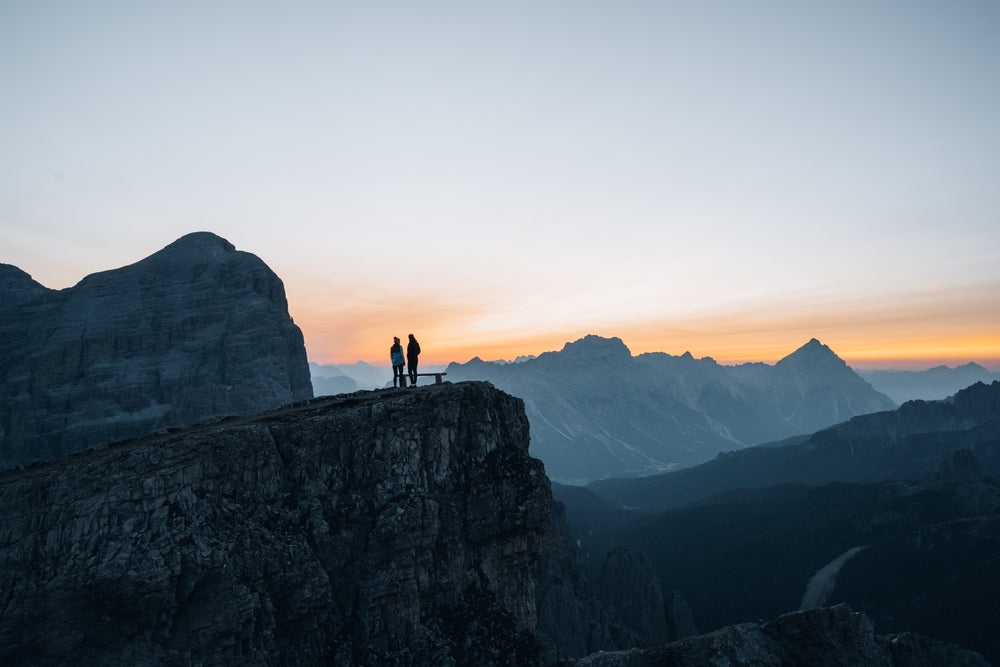
There is a marriage proposal on a summit. The one asking is trembling — not from the cold. The other says yes, and for a fraction of a second, the entire landscape seems to hold its breath. From that day on, that mountain is no longer a mountain. It is their mountain. It has changed in nature.
There is a first kiss in a cobblestone alley, on a July evening. The light was orange. It smelled of warm stone. Two decades later, every slightly dark cobblestone alley brings something back — a lightness, a promise, the precise dizziness of that moment.
There is a beach where someone left for good. Since then, the waves there have a different sound.
Places absorb what happens in them. They become receptacles for emotions, living archives of what we have been through. And long after the people are gone, after the seasons have turned, after the cities have changed their face — these places continue to glow softly in our memory.
To return, or not to return
Some people go back. To check that it's still there. To find something again. Sometimes it works — the emotion returns, intact, as if the ground itself had kept it in reserve. Sometimes it doesn't — the café has closed, the light is different, and you leave with a strange sadness, the sadness of not having known it was a last time.
Others don't go back. By choice. Because the memory is too precious to risk breaking. Because the place as it exists in memory is more beautiful, more accurate, more whole than any present reality.
In either case, what we're looking for is not really the place itself. It's what we left there.
Keeping a place
You can't hold onto time. But you can hold onto a place.
Not with a photograph — a photograph captures the surface, the light of a moment, but rarely what was happening underneath. Not with words either — words are too precise, or not precise enough.
But with something that resembles the geography of the place itself. Its curves, its reliefs, its lines. The exact shape of that mountain, that island, that valley. Something that says: it was there. Something that makes it present without freezing it. That places it in a space, on a wall, in a room — and means you can keep living with it.
Some places deserve to stay. Not in a drawer. Not on a phone. Somewhere you see them every day, where they quietly continue their work — reminding you of who you were, what you lived through, and everything a point on a map can contain when you've left something essential there.